
9,000 Days of Guantánamo
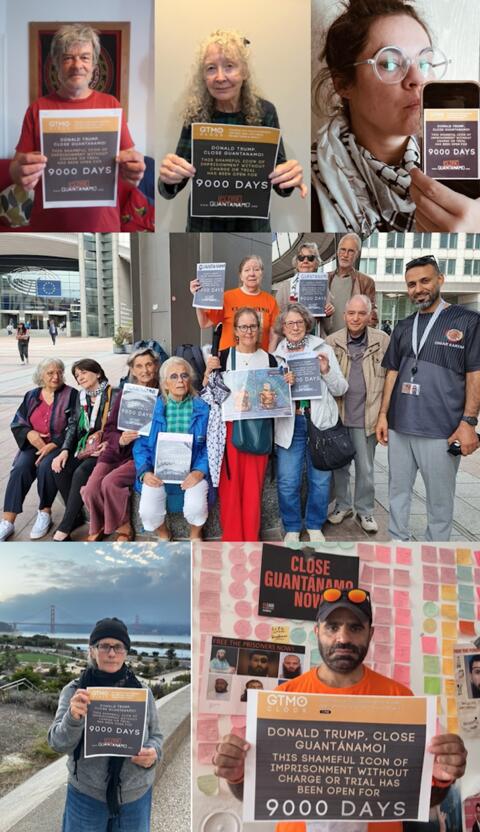
Six photos from the 51 we received in total marking 9,000 days of Guantánamo's existence.
If you can, please make a donation to support our work throughout the rest of 2026 and into 2027. If you can become a monthly sustainer, that will be particularly appreciated. Tick the box marked, "Make this a monthly donation," and insert the amount you wish to donate.
By Andy Worthington, September 9, 2026
In two days’ time, the U.S. and the wider world will mark the 25th anniversary of the 9/11 attacks, but there will, almost certainly, be little reflection on the U.S.’s brutal response, which continues to have repercussions both domestically and internationally.
In the global “war on terror” declared by the Bush administration, the inviolability of national borders and national sovereignty were swept aside as the entire world was declared a battlefield, torture was adopted as covert but official U.S. government policy, numerous individuals were kidnapped and “rendered” to CIA “black site” torture prisons scattered across the globe, thousands of wartime prisoners were unlawfully deprived of their rights under the Geneva Conventions, and, at Guantánamo Bay in Cuba, a U.S. naval base became home to a notorious detention facility, — where those held were categorized, without precedent, as “unlawful enemy combatants”, human beings without any fundamental rights whatsoever — and whose ongoing existence is the last blatant physical reminder of more than two decades of state-inflicted terror.
9,000 days of Guantánamo: a timeline of lawlessness
Foreshadowing the 25th anniversary of 9/11, last week, on September 2, campaigners across the U.S. and around the world held the 44th consecutive monthly vigils calling for Guantánamo’s closure, also marking a grotesque milestone — 9,000 days of the existence of the prison, where, since January 11, 2002, 779 men and boys have been held by the U.S. military; that’s 24 years, seven months and 22 days of the existence of a facility that was specifically set up to enable the torture and abusive interrogations of men and boys largely rounded up arbitrarily — or bought for bounty payments — in Pakistan, and to a lesser extent, in Afghanistan.
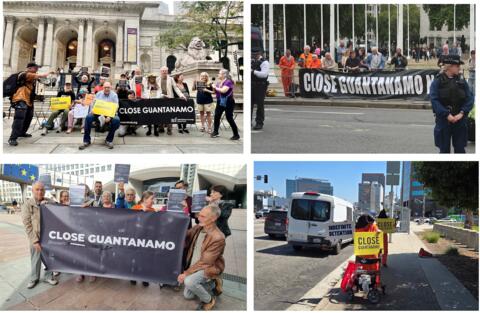
Photos from the monthly vigils for Guantánamo’s closure on September 2, 2026.
750 of these prisoners arrived at Guantánamo between January 11, 2002 and November 2003, when the steady flow of prisoners from brutal processing facilities in Afghanistan (primarily, the notorious prison at Bagram Airbase) came to an end.
All were allegedly involved with Al-Qaeda or the Taliban, with the clear distinction between Al-Qaeda and the Taliban routinely ignored, and with a strong inference that they were involved in or had knowledge of the 9/11 attacks, but no adequate screening process had taken place to establish whether or not there was any truth to these claims before they were sent to Guantánamo.
Nine more prisoners arrived at Guantánamo from CIA “black site” torture prisons, established in five countries around the world — Thailand, Poland, Romania, Lithuania and Morocco — in September 2004, and another 14 — the so-called “high-value detainees” — arrived from the “black sites” 20 years ago, on September 3, 2006. The final six prisoners arrived from various locations worldwide between March 2007 and March 2008.
No one with any alleged “terrorism” involvement has been sent to Guantánamo for the last eighteen and a half years, but those held, for the most part on an evidence-free basis, based on innuendo and hearsay and unreliable information extracted through the use of torture and other forms of abuse, have struggled to secure release from a facility that was designed to be their final destination — a one-way trip to legal oblivion.
Over the years, as the initial post-9/11 hysteria died down, and countries that had complied, whether willingly or unwillingly, with the Bush administration’s demand for co-operation, began calling for the release of their citizens, all but 15 of these 779 prisoners were released, although very few were freed through any kind of recognizable legal process.
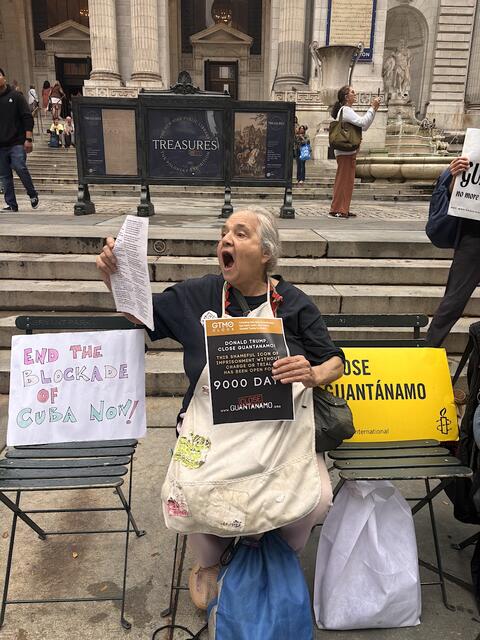
An excellent photo of Judith, a campaigner in New York City, singing at the vigil on September 2, 2026.
Brave and tenacious lawyers fought to years to secure habeas corpus rights for these men — the right to have their cases heard before an impartial judge — securing victory in June 2004, when, in Rasul v. Bush, the Supreme Court granted them habeas rights, largely on the basis that if, as many of them claimed, they had been seized by mistake, no legal avenue whatsoever existed for them to challenge the basis of their imprisonment.
That ruling allowed lawyers into Guantánamo, to begin representing those held, a development that brought a two-and-a-half year policy of hidden abuse to an end. But court cases were delayed for another four years, after a pliant Congress passed laws designed to prevent the prisoners from exercising their habeas rights.
Finally, in June 2008, the Supreme Court ruled again, in Boumediene v. Bush, that the prisoners had constitutionally guaranteed habeas rights, and for two years the law finally reached Guantánamo.
32 men had their release ordered by federal court judges in Washington, D.C. between 2008 and 2010, until the D.C. Circuit Court (the Court of Appeals) passed a number of politically motivated rulings on appeals submitted by the government, which finally shut down habeas as a viable route out of Guantánamo.
As a result, almost everyone released from Guantánamo has been freed through legally unreviewable administrative review processes whose closest analogy is the State of Israel’s policy of “administrative detention” for Palestinian prisoners, which allows them to be held indefinitely without charge or trial, via orders that can be renewed every six months. This was inherited from Palestine’s transitional British overseers, from 1920 to 1948, who used it to suppress Palestinian resistance.
Apart from the 32 men released via the courts (and a 33rd who managed to secure a favourable habeas ruling in 2021), the only other prisoners who have been freed through any kind of legal process are the nine men released after being sentenced in the military commissions, the broken trial system unwisely dredged up from the history books after 9/11.
All but one of these releases took place as a result of plea deals, rather than through the more evidentially demanding process of a trial, and three of the convictions have, after the men’s release, been overturned on appeal.
Who are the 15 men still held?
Of the 15 men still held, only three arrived at Guantánamo in its earliest years of operations — all in 2002. Ten were amongst the 14 “high-value detainees” who arrived at Guantánamo from the “black sites” in September 2006, while the two others, also regarded as “high-value detainees,” arrived in 2007 and 2008.
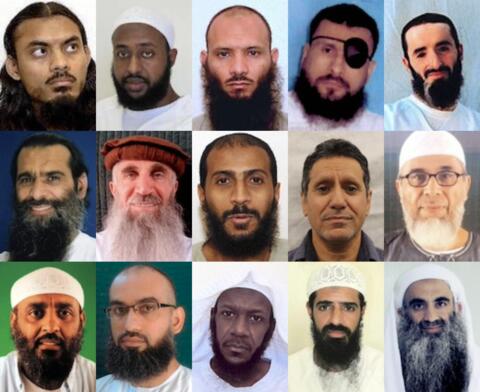
The 15 men still held at Guantánamo.
Of the three who arrived in 2002, one, Ali Hamza Al-Bahlul, was on the very first flight into the prison on January 11, 2002. A self-confessed member of Al-Qaeda, he reportedly made a promotional video celebrating the 9/11 attacks, but refused to allow himself to be represented by his defense lawyers at his military commission trial in October 2008, where he received a life sentence, which he has, for the most part, served in solitary confinement, in defiance of internationally agreed standards of detention that are meant to prevent prolonged solitary confinement.
His isolation wasn’t even deliberate. The U.S. authorities thought that he would be joined by other convicted prisoners, but the military commissions have struggled to such an extent to establish their legitimacy that he has only ever been accompanied, in his isolated cell block, on a few occasions by prisoners who have been convicted via plea deals and have subsequently been released.
The second man, Muieen Abd Al-Sattar, arrived at Guantánamo on February 9, 2002, and is a ghost within the system, a stateless Rohingya Muslim who has refused to engage with the authorities and has, by his own choice, never had any legal representation. He is listed as an Emirati, but although he was born there, he apparently spent most of his life, pre-capture, in Saudi Arabia, and has a Pakistani passport, although he is not recognized as a Pakistani citizen.
In 2009, during the deliberations of the Guantánamo Review Task Force, the first of two administrative review processes set up under President Obama, he was approved for release, but, throughout all the various negotiations in the years since to find new homes in third countries for stateless prisoners, or those who cannot be repatriated — either through fears for their safety, or because Congress has designated them as a security risk — no country has ever offered him a home.
The third man, Ismael Ali Bakush, a Libyan, arrived at Guantánamo on August 5, 2002. in 2013, he was included in a list of 64 prisoners eligible for review by a Periodic Review Board, Obama’s second administrative process, designed to assess whether the prisoners in question were still regarded as a security risk, or whether they could be freed. Turned down for release in 2016 and 2020, he was finally approved for release by a PRB under President Biden in September 2022, but, because Libya is a destination banned by Congress, a third country had to be found that was prepared to resettle him, and, as with Al-Sattar, no country has offered him a home.
Another man approved for release but still held is Guled Hassan Duran, a Somali seized in Djibouti in March 2004, who was one of the 14 “high-value detainees” who arrived at Guantánamo from CIA “black sites” in September 2006. Never charged, no information was ever provided to justify his imprisonment, and he was finally approved for release by a PRB under President Biden in November 2021. However, because Somalia is a destination banned by Congress, a third country had to be found that was prepared to resettle him, and, as with Al-Sattar and Ali Bakush, no country has offered him a home.
Three other men are “forever prisoners” — held indefinitely without charge or trial, but never charged with a crime. Theoretically, their PRBs could recommend them for release, but this has never happened. Every few years, their cases are reviewed, and every time they continue to be regarded as a security risk.
The most well-known of the three, by far, is Abu Zubaydah, the Saudi-born stateless Palestinian for whom the CIA’s “black site” torture program was first developed after his capture in Pakistan in March 2002. Horrendously tortured in the four and a half years before he arrived at Guantánamo in September 2006, on the mistaken basis that he was a key figure in Al-Qaeda, he continues to be held, even though the U.S. authorities have walked back from all of the outrageous claims that they initially made about his significance.
The second man, Abu Faraj Al-Libi, a Libyan, also arrived at Guantánamo in September 2006, after being held in CIA “black sites” following his capture in Pakistan in May 2005. Reportedly in poor health, he was initially described as a senior member of Al-Qaeda, but no explanation has ever been provided about why he has never been charged, and why his PRBs continue to recommend his ongoing imprisonment without charge or trial.
The last of the three “forever prisoners” is Muhammad Rahim, an Afghan who was the last prisoner to arrive at Guantánamo in March 2008. Although he was described as an aide to Osama bin Laden, no explanation has been provided as to why, as with Al-Libi, he has never been charged, and why his PRBs continue to recommend his ongoing imprisonment without charge or trial.
Of the eight other men, seven have been charged in the military commissions, while one has been convicted via a plea deal — Abd Al-Hadi Al-Iraqi, an Iraqi military commander, and Guantánamo’s most severely physically disabled prisoner, because of a degenerative spine disease, who accepted a plea deal in 2022 and is scheduled to be released in 2032, if a third country can be found that will give him the lifelong care that he needs.
Five of the seven charged — Khalid Shaykh Mohammad (KSM), Ramzi Bin Al-Shibh, Walid Bin Attash, Mustafa Al-Hawsawi and Ammar Al-Baluchi — were allegedly involved in facilitating and planning the 9/11 attacks, but efforts to prosecute them have been fruitless, in large part because of the torture to which they were subjected in the CIA’s “black sites”, because the use of torture is incompatible with justice.
Although they were arraigned in 2012, prosecutors finally conceded in 2022 that successful prosecutions would be impossible, and began negotiating plea deals for three of the men, which would have taken the death penalty off the table in exchange for full and frank explanations of their role in the attacks, and life imprisonment at Guantánamo. One of the five, Ammar Al-Baluchi, chose to pursue a separate legal route to challenge the basis of his imprisonment, while the other man, Ramzi Bin Al-Shibh, is in legal limbo, after a DoD Sanity Board decided in August 2023 that he was mentally unfit to stand trial because of lasting psychosis caused by his torture.
These plea deals were confirmed in August 2024, but were then recklessly overturned by Biden’s defense secretary Lloyd Austin, in a legally dubious manner, hurling the men back into a legal limbo. As of now, on the eve of the 25th anniversary of the 9/11 attacks, a trial date has been set for 2028, but with no real expectations that this will actually happen, especially because the new judge in the 9/11 case — the fifth to assume that role — recently ruled as inadmissible prosecutors’ key evidence, a confession KSM made to a so-called “clean team” of FBI interrogators after his arrival at Guantánamo, using non-coercive methods, but which was ruled as inadmissible because it was not regarded as free of the influence of his previous torture.
Abd Al-Rahim Al-Nashiri, the alleged mastermind of the bombing of the USS Cole in 2000, in which 17 U.S. sailors were killed, is also caught up in endless pre-trial proceedings. Arraigned in November 2011, his trial is supposed to begin with the selection of a jury next month, but again there are profound evidentiary problems, as, in August 2023, one of his judges, before retiring, also ruled as inadmissible confessions he had made to an alleged “clean team” of FBI interrogators.
Meanwhile, no trial date has even been tentatively set for Riduan Isamuddin, also known as Hambali, the former military head of the Indonesian terrorist organization Jemaah Islamiyah, who was only arraigned in 2021, 18 years after his capture, and 15 years after his arrival at Guantánamo.
In conclusion, as you digest all this information, please bear in mind that January 11, 2027 marks the 25th anniversary of the opening of Guantanamo, when, I hope, there will be a renewal of interest in its enduring status as a legal, moral and ethical abomination, and renewed calls for its closure.