The Torture Drawings of Abu Zubaydah, Guantánamo’s “Forever Prisoner”
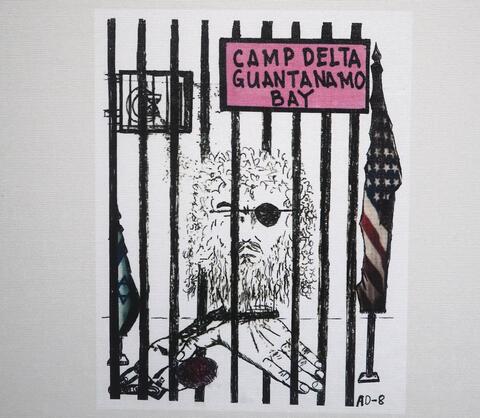
A self-portrait by Abu Zubaydah, from the exhibition, "Art from Guantánamo, by Abu Zubaydah."
If you can, please make a donation to support our work throughout 2026. If you can become a monthly sustainer, that will be particularly appreciated. Tick the box marked, "Make this a monthly donation," and insert the amount you wish to donate.
By Andy Worthington, May 19, 2026
The exhibition, "Art from Guantánamo, by Abu Zubaydah," currently on display at the LSE (London School of Economics), shows the true face of U.S. barbarism, through a collection of drawings, by Abu Zubaydah himself, depicting his horrific torture in CIA "black sites" during the four and a half years that he was held before being transferred to Guantánamo in September 2006, where he has been held ever since — in other words, for nearly 20 years — without charge or trial.
The exhibition was organized by his international lawyer Helen Duffy, through her Human Rights in Practice law firm, LSE Law School and Human Rights in the Picture, and, if you’re in London, or anywhere near, please do consider visiting it. Entry is free, and it runs until June 5.
Although the U.S. authorities initially touted Abu Zubaydah, whose real name is Zayn Al-Abidin Muhammad Husayn, as the No. 3 in Al-Qaeda, after seizing him in a house raid in Faisalabad, Pakistan, on March 28, 2002, they have since walked back from all their claims, and yet they still refuse to release him, or even to approve him for release, via the Periodic Review Boards.
This is an administrative review process established under President Obama, which, over the last 13 years, has approved 58 prisoners for release, all but two of whom have been freed. Like Abu Zubaydah, however, two other men are also still held as "forever prisoners," who have never been charged with a crime, but haven’t been approved for release either — Abu Faraj Al-Libi, a Libyan, and Muhammad Rahim, an Afghan.
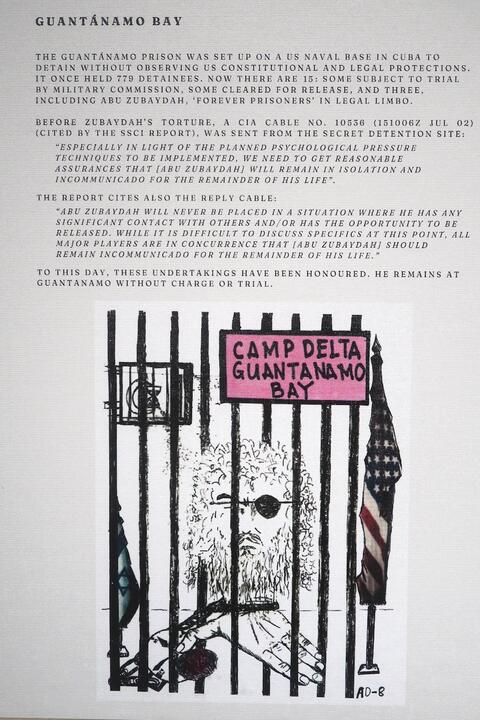
The opening display board, featuring the CIA's request for Abu Zubaydah to be detained incommunicado for the rest of life, as discussed below.
The exhibition opened last Tuesday, May 12, and I was grateful to attend it — even though nothing can really prepare the viewer for the horrors on display. I recommend it for its unique insight into what it means for Abu Zubaydah not only to have been tortured horrifically by CIA operatives in "black site" torture prisons around the world, but also to have been so ruthlessly silenced by his torturers, and so deprived of meaningful human contact or any kind of psychological support, that these pictures represent his only means of communicating with the outside world, and of trying to come to terms with the trauma of the torture he endured, which is almost beyond imagining.
While nothing, of course, can compare to the sickening depravity of Abu Zubaydah’s torture, the way he has been silenced for nearly the last 20 years, since his arrival at Guantánamo, and the way that he, and all the other prisoners still held who were held and tortured in “black sites” — eleven of the 15 men still held in total — have been denied adequate medical treatment or any kind of psychological counselling is a cruel and unforgivable extension of their torture.
We don’t hear their words because official U.S. military censorship processes prevent us from hearing them. Every word uttered at Guantánamo between the prisoners and their lawyers is presumptively classified, and nothing can be released without clearance, which, in the case of the "high-value detainees" like Abu Zubaydah and the ten other men held in "black sites," is rarely forthcoming.
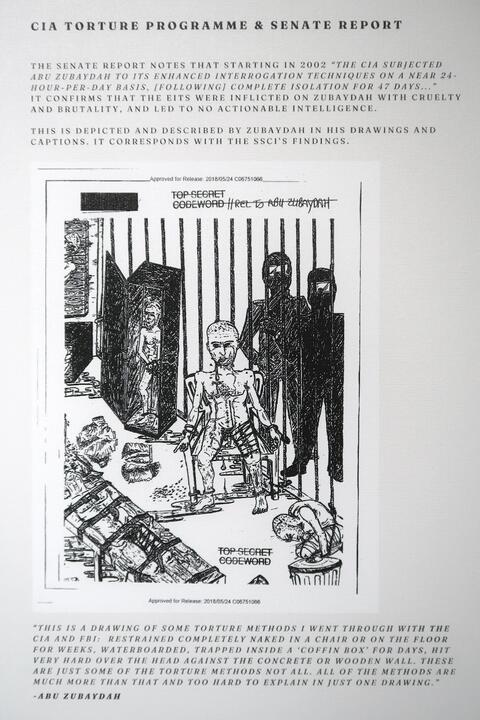
Abu Zubaydah's drawing of some of the torture techniques he endured in the CIA "black sites."
Nor do we hear about the medical and psychological neglect of these men, because of the secrecy that still engulfs Guantánamo, despite the many colossal efforts by lawyers to open it up to scrutiny over the last 24 years. In defiance of international law, no psychological counselling has ever been made available to these men, and, in addition, any medical needs they have can only be addressed through the limited facilities available on the naval base where the Guantánamo prison is located. Provisions in the annual National Defense Authorization Act (NDAA), inserted by Republicans in Obama’s early years, and maintained ever since, prevent any Guantánamo prisoner from being taken to the U.S. mainland for any reason, including for urgent medical treatment that is unavailable at Guantánamo itself.
As it is so rare to hear anything from these men — and, in Abu Zubaydah’s case, because he was specifically subjected to a request to CIA headquarters by his interrogators that, if he survived their torture, he would remain detained incommunicado for the rest of his life — this exhibition provides a unique opportunity to pierce this veil of secrecy and to hear directly from one of the most severely brutalized and silenced individuals not only in the "war on terror," but in the whole of the U.S.’s long and brutal history.
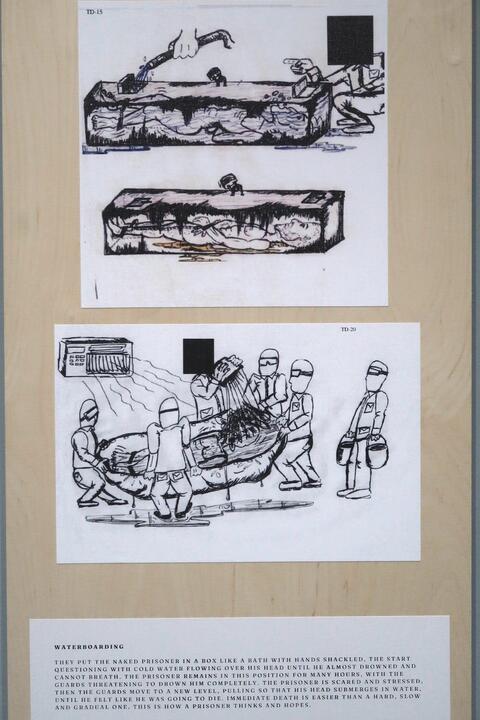
Abu Zubaydah's depictions of being subjected to waterboarding, an ancient torture technique to which he was subjected on 83 separate occasions.
Below are some more of Abu Zubaydah’s drawings, all of which, rather miraculously, were unclassified and publicly released by the U.S. authorities. His original drawings are shown in glass cases at the exhibition, and a photo of one of these is included, of force-feeding at Guantánamo. Those shown on the walls, however, are photocopies, although they’re accompanied by descriptions of what is portrayed, made by Abu Zubaydah to his lawyers, which were also unclassified. Also included is a more recent drawing, including elements of collage, which is his response to world events in 2021, and, in particular, the murder of George Floyd in 2020, and the Black Lives Matter movement.
Over the years, the U.S. has repeatedly been condemned by international bodies for its treatment of Abu Zubaydah, via two rulings by the European Court of Human Rights in 2014 and 2018, by the U.N. Working Group on Arbitrary Detention in 2023, and by its own Senate’s Intelligence Committee, in a report in 2014. In the ECHR rulings, Poland and Lithuania, which hosted CIA torture prisons, were obliged to pay him significant damages, and further substantial damages were paid by the U.K. government in January this year, based on their complicity in his torture.
Noticeably, however, despite the ongoing injustice of Abu Zubaydah’s imprisonment without charge of trial, the torture to which he was subjected is now, sadly, evidently regarded in some way as ancient history by the U.S. government, which has, so far at least, evaded accountability for its actions, and continues to ignore those calling for his release.
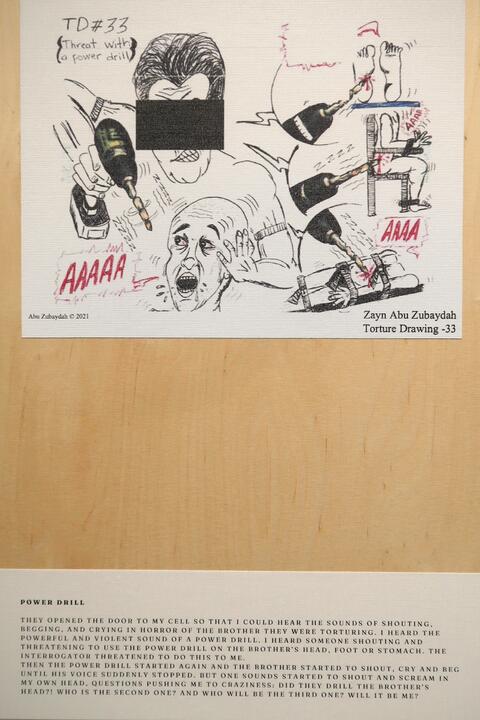
Abu Zubaydah's depiction of another "black site" prisoner, not him, being threatened with an electric drill.
To understand how true this is, imagine if an exhibition had been proposed at LSE featuring torture drawings by a Palestinian held for years without charge or trial in Israel’s brutal prisons for Palestinians, comparable to the U.S.’s horrific prisons in the "war on terror," where torture, abuse and rape are widespread.
The uproar would have been be deafening, and there is no way that such an exhibition would have been allowed to proceed.
The grim irony is that, although Abu Zubaydah was born in Saudi Arabia, his parents are Palestinians, from the West Bank, and, like all foreigners living and working in Saudi Arabia, they were not granted Saudi citizenship. Even if, one day, Abu Zubaydah is approved for release, he cannot be freed in the West Bank, because Israel is the gatekeeper, and has persistently refused to contemplate repatriation for the handful of other Palestinians held at Guantánamo, who had to be resettled in third countries.
The U.S. tortured him and deprived him of all rights as a human being, but it is Israel that has made him stateless.
This is a situation that must increase the resolve of anyone who cares about Abu Zubaydah’s plight to push for an amenable third country to offer him a new home.
Perhaps pressure to this end can be increased through this compelling exhibition also being shown in other countries. If you can help with that, do contact Helen Duffy through her website.
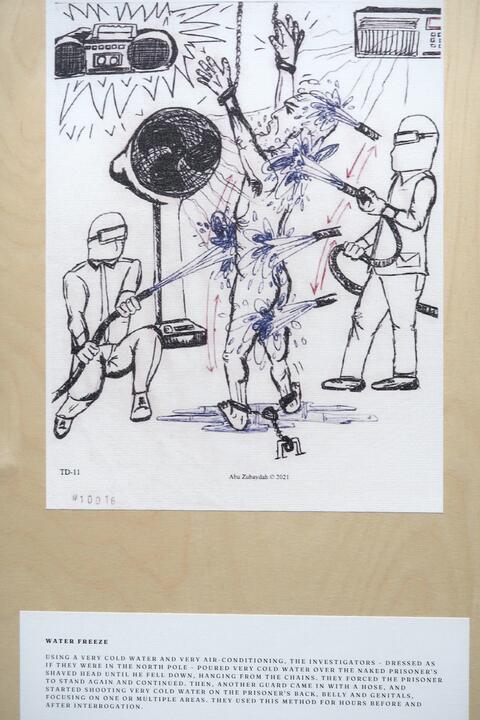
Abu Zubaydah's portrayal of being subjected, while naked and chained, to being sprayed with freezing cold water, while excruciatingly loud music was also being played.
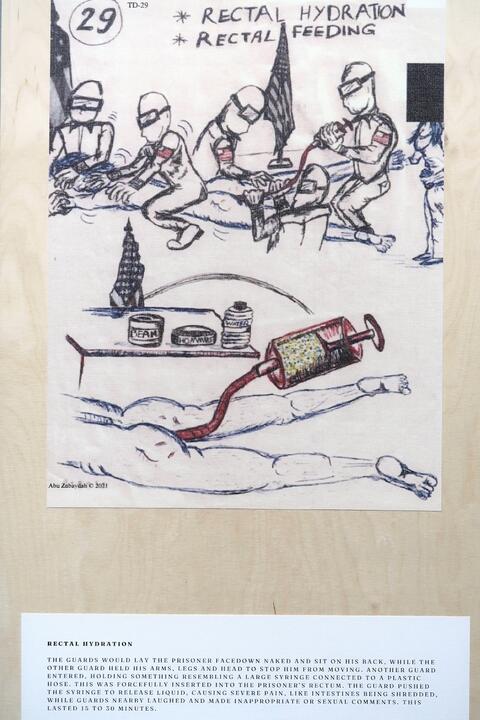
The horrors of "rectal feeding," or "rectal hydration."
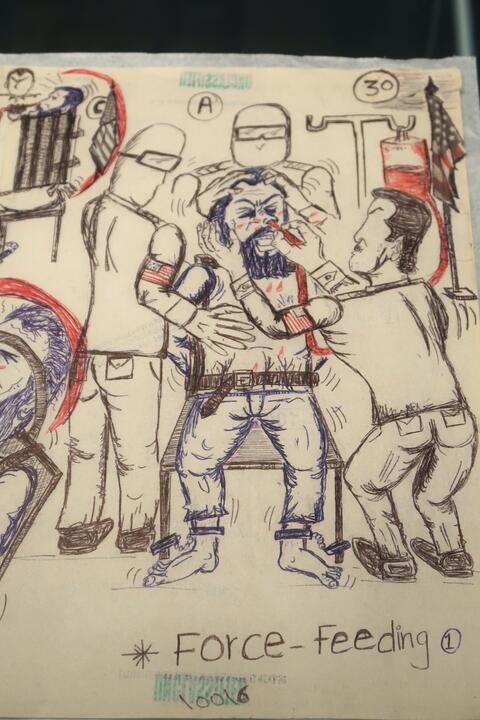
A photo of one of Abu Zubaydah's original drawings, of force-feeding taking place at Guantánamo.
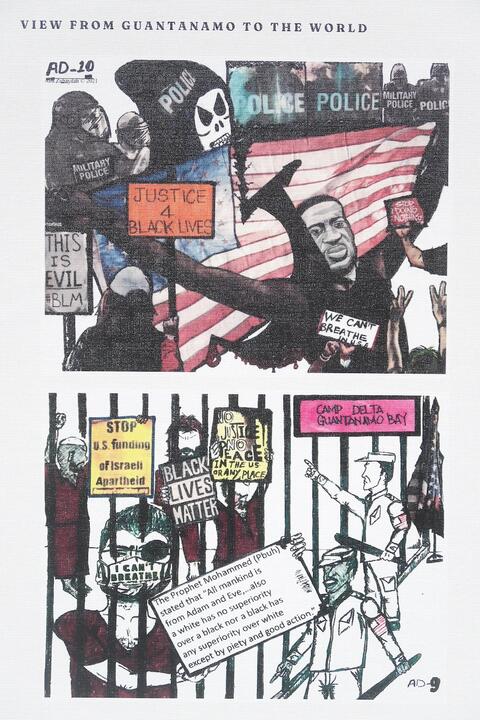
Abu Zubaydah's more recent drawing, including elements of collage, which is his response to world events in 2021, and, in particular, the murder of George Floyd in 2020, and the Black Lives Matter movement, although it also, even before the last two and a half years of genocide in Gaza, includes a reference to Israeli apartheid.
Note: For a Spanish version, "Los dibujos de Abu Zubaydah bajo tortura, el 'prisionero para siempre' de Guantánamo", on the World Can't Wait's Spanish website, see here.