On U.N. Torture Day, Don’t Forget the Victims at Guantánamo
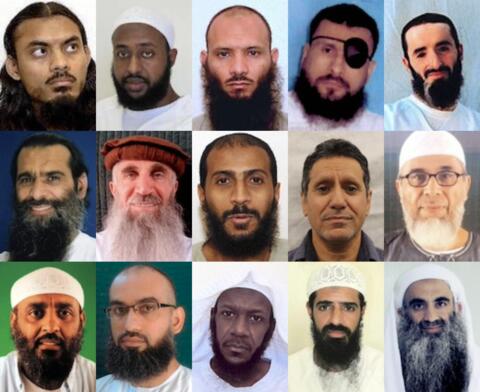
The 15 men still held at Guantánamo. Top row, from L to R: Muieen Abd Al-Sattar, approved for release 16 years ago, Guled Hassan Duran and Ismael Ali Bakush, also approved for release, and "forever prisoners" Abu Zubaydah and Abu Faraj Al-Libi. Middle row: "Forever prisoner" Muhammad Rahim, Abd Al-Hadi Al-Iraqi, convicted via a plea deal, Ali Hamza Al-Bahlul, serving a life sentence, and Abd Al-Rahim Al-Nashiri and Riduan Isamuddin, both facing charges. Bottom row: The 9/11 co-accused: Ramzi Bin Al-Shibh, removed from the case because a DoD Sanity Board ruled that he was unfit to stand trial, Ammar Al-Baluchi, and three others currently wrangling over plea deals — Mustafa Al-Hawsawi, Walid Bin Attash and Khalid Sheikh Mohammed.
If you can, please make a donation to support our work throughout 2026. If you can become a monthly sustainer, that will be particularly appreciated. Tick the box marked, "Make this a monthly donation," and insert the amount you wish to donate.
By Andy Worthington, June 26, 2026
Today, June 26, is U.N. Torture Day, or, to give it its full name, the International Day in Support of Victims of Torture, marked annually since 1998, and initiated to mark the date in 1987 when the U.N. Convention Against Torture and Other Cruel, Inhuman or Degrading Treatment or Punishment came into force.
Although the U.S. signed the Convention, under Ronald Reagan, on April 18, 1988, it took over seven years for it to be officially ratified, under Bill Clinton, on September 19, 1994, and it was fundamentally jettisoned seven years later, immediately after the terrorist attacks on September 11, 2001, when George W. Bush "signed a covert action Memorandum of Notification (MON) to authorize the director of central intelligence (DCI) to 'undertake operations designed to capture and detain persons who pose a continuing threat of violence or death to U.S. persons and interests or who are planning terrorist activities.'"
That memorandum has never been publicly released, but it was cited in the U.S. Senate Intelligence Committee’s report into the CIA’s torture program, whose 500-page executive summary was released in December 2014, painstakingly reporting and assessing the horrors that the memorandum had unleashed.
As the report’s authors explained, "Although the CIA had previously been provided limited authorities to detain specific, named individuals pending the issuance of formal criminal charges, the MON provided unprecedented authorities, granting the CIA significant discretion in determining whom to detain, the factual basis for the detention, and the length of the detention."
In addition, although the memorandum "made no reference to interrogations or interrogation techniques," the Senate report established that, three days earlier, on September 14, 2001, a senior CIA official had sent an email to certain CIA Stations "seeking input on appropriate locations for potential CIA detention facilities."
Over the next six months, the plans for the unprecedented detention of — and interrogation of — individuals who allegedly posed a threat to the U.S. initially involved discussions about using U.S. military bases abroad. However, after warnings that, "as captured terrorists may be held days, months, or years, the likelihood of exposure will grow over time," the plans eventually coalesced around an agreement that secretive facilities in other supportive countries would provide the best option of maintaining secrecy.
This was despite warnings by some CIA officials that "media exposure could inflame public opinion against a host government and the U.S., thereby threatening the continued operation of the facility," and that hosting "black sites" in other countries "poses uncontrollable risks that could create incidents, vulnerability to the security of the facility, bilateral problems, and uncertainty over maintaining the facility."
After settling on the use of "short-term facilities," the "black site" program opened in a facility in Thailand in March 2002, shortly after the capture of the first alleged "high-value detainee," Abu Zubaydah, the facilitator of an independent training camp in Afghanistan, who was seized in a house raid in Faisalabad, Pakistan on March 28, 2002. Mistakenly identified as a senior figure in Al-Qaeda, he was subjected to severe torture, including being subjected to waterboarding, an ancient form of water torture, on 83 separate occasions. Recently, disturbing drawings he made of his own torture were shown at an exhibition in London, as we reported here.
Ignoring the fact that, in 1989, senior CIA officials had informed the Senate Committee on Intelligence that "inhumane physical or psychological techniques are counterproductive because they do not produce intelligence and will probably result in false answers," the CIA under George W. Bush embarked on a torture program, directed by two psychologists who had worked for the U.S. Air Force’s SERE program (Survival, Evasion, Resistance, Escape), which trained U.S. personnel how to resist torture if they fell into enemy hands.
Despite having no experience of real-life interrogation, Mitchell and Jessen reverse-engineered the SERE program, personally oversaw it and engaged in it, and were paid $81 million for doing so, until their contract was eventually terminated after a CIA Inspector General report concluded that there was no scientific reason to believe that the program was either medically safe or would produce reliable information.
Over four and a half years, from March 2002 onwards, the CIA torture program involved the establishment of "black site" torture prisons firstly in Thailand, and then in Poland, Romania, Lithuania, Morocco and Afghanistan, as well as, briefly, within the “war on terror” prison established by the U.S. military at Guantánamo Bay.
The Senate report established that at least 119 individuals were held in total.
14 of these men were, like Abu Zubaydah, identified as "high-value detainees," and around 40 of the "black site" detainees in total were eventually transferred to Guantánamo. The last to arrive were the 14 "high-value detainees," transferred in September 2006, when the "black sites" were closed following a critical Supreme Court ruling reminding the government that every prisoner it held was protected by Common Article 3 of the Geneva Conventions, which prohibits torture and abuse.
Guantánamo today, and the taint of torture that still clings to it
Today, just 15 men are still held at Guantánamo, although the U.S.’s use of torture still weighs heavily on the facility.
Ten of the 15, all designated as "high-value detainees," and including five men allegedly responsible for the 9/11 attacks, amongst them the alleged mastermind, Khalid Sheikh Mohammed, were specifically subjected to the most devastating acts of torture in the "black sites," while two others, brought to the prison in 2007 and 2008, after the official torture program ended, were also designated on arrival as "high-value detainees."
Of these 12 men, only eight have been charged with crimes, and yet, because torture is fundamentally incompatible with justice, efforts to successfully prosecute them — in a special trial system, the military commissions, which was dredged up from the history books specifically to deal with their cases — have limped on for over two decades now without the government ever being able to bring most of their cases to trial.
Of the eight, only one case has concluded, via a plea deal — that of Abd Al-Hadi Al-Iraqi, an Iraqi military commander, and Guantánamo’s most profoundly physically disabled prisoner, who agreed to a plea deal in 2022, and is supposed to be freed in 2032. Of the seven others, only six cases are ongoing, after one of the alleged 9/11 co-conspirators, Ramzi Bin Al-Shibh, was ruled mentally unfit to stand trial, because of his torture, by a DoD Sanity Board in 2023.
Through the long decades of the military commissions’ existence, only eleven men, including Al-Iraqi, have been successfully prosecuted, in cases mostly involving lower-level detainees. Only two involved trials, while the other nine convictions were agreed via plea deals.
Of those eleven convictions, three have been overturned on appeal, while, in another case, that of Ali Hamza Al-Bahlul, a publicist for Al-Qaeda, who is serving a life sentence at Guantánamo in solitary confinement, after refusing to mount a defense at his trial in 2008, all the charges were subsequently overturned on appeal except one, which was dubiously upheld after a fractured ruling in which the judges were divided.
For the "high-value detainees," convictions seem impossible, and yet successive governments have refused to accept reality, driven by a desire for vengeance, and for the imposition of the death penalty, in spite of expert advice to the contrary.
When prosecutors in the planned 9/11 trial finally recognized, in 2022, that successful prosecutions were indeed impossible, they began working with the defense teams for three of these men, and the commissions’ military overseer, the Convening Authority, to negotiate plea deals in which, in exchange for them testifying about their guilt, the death penalty would be taken off the table, and they would be held for the rest of their lives at Guantánamo.
Plea deals for the three men were agreed in August 2024, but this was intolerable for Lloyd Austin, President Biden’s defense secretary, who immediately revoked them, hurling the men back into a legal limbo.
For the six men currently changed, no trial dates are even on the horizon, and, just as crucially, as we remember the absolute prohibition on the use of torture on this particular day, no U.S. official has been held accountable for their involvement in the CIA torture program.
Of the other six men still held, all are held indefinitely without charge or trial. Three — all "high-value detainees," including Abu Zubaydah — are known as the “forever prisoners,” because, despite never being charged, they haven’t been approved for release either.
Three others — including another "high-value detainee," the Somali prisoner Guled Hassan Duran — are still held despite having long been approved for release by high-level U.S. government review boards.
The other two men — a hapless Libyan, Ismael Ali Bakush, and a stateless Rohingya, Muieen Abd Al-Sattar, who was approved for release 16 years ago — were never held in "black sites," but the use of torture has also infected their lives.
In 2023, when a U.N. Special Rapporteur, Fionnuala Ní Aoláin, finally visited Guantánamo, she concluded, in her report, that the rights violations at the prison, despite some improvements over the years, were such that "the totality of these factors, without doubt, amounts to ongoing cruel, inhuman, and degrading treatment at the Guantánamo Bay detention facility, and may also meet the legal threshold for torture."
That same year, the U.N. Working Group on Arbitrary Detention, reporting on the case of Abu Zubaydah, reached a similar conclusion, finding not only that his imprisonment was "arbitrary," but also that the very basis of the detention system at Guantánamo — involving "widespread or systematic imprisonment or other severe deprivation of liberty in violation of fundamental rules of international law" — "may constitute crimes against humanity."
Under Trump, no one cares, but one day there will need to be a reckoning. The existence of Guantánamo, and the whole of the "war on terror" detention program — including the "black sites" and the military detention facilities operated in Afghanistan and Iraq during the U.S. occupations of both countries — constitutes nothing less than the most indelible moral stain on any illusions the U.S. has that it is a nation founded on the rule of law, and which respects the rule of law.
Guantánamo is, and always has been, a legal, moral and ethical abomination, and it remains so to this day.
Note: For a Spanish translation, on the World Can't Wait's Spanish website, see "En el Día de las Naciones Unidas contra la Tortura, no olvidemos a las víctimas de Guantánamo" here.