
Close Guantánamo Joins 85 Other Organizations Opposing Plans to Hold Cuban Migrants at Guantánamo
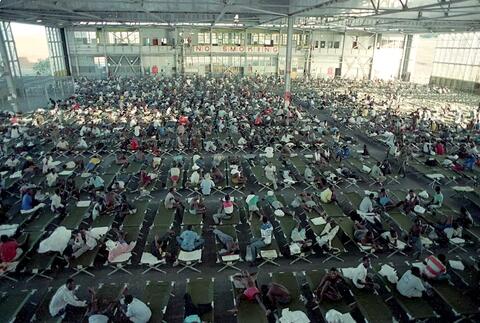
Haitian migrants detained at Guantánamo in December 1991. (Photo: Chris O'Meara/AP).
If you can, please make a donation to support our work throughout 2026. If you can become a monthly sustainer, that will be particularly appreciated. Tick the box marked, "Make this a monthly donation," and insert the amount you wish to donate.
By Andy Worthington, April 16, 2026
Guantánamo has gone quiet of late, which is never good news, as it means that the 15 men still held, in varying states of fundamental lawlessness, are even more forgotten than has generally been the case throughout the prison’s long and sordid history.
In his first term in office, Donald Trump largely sealed the prison shut for four years, but last year, when he took office for the second time, he briefly managed to bring the prison back into the world’s consciousness when he decided to start using it to hold immigrants targeted as part of his vile promise to undertake the largest deportation program in U.S. history.
Beginning in February last year, close to 800 immigrants have been held at Guantánamo, either in an existing Migrant Operations Center, first used to hold migrants intercepted at sea in the 1990s, or, illegally, in a cell block of the "war on terror" prison, established in January 2002, where the 15 men lawlessly detained in the "war on terror" are still held.
Mostly, it seems, the decision to use Guantánamo for immigrants was as an act of performative cruelty, drawing false analogies between the hapless migrants sent there and the 779 men held by the U.S. military in the "war on terror" prison, who, as the first of them arrived on January 11, 2002, were falsely described as "the worst of the worst" terrorists by then-defense secretary Donald Rumsfeld.
I wrote extensively about the scandal of the immigrants sent to Guantánamo last year — first, about the Venezulans held in February, and then repatriated (see here, here, here, here and here), and then following up as, throughout the year, other migrants from a variety of countries were held, before they too were, for the most part, repatriated, or sent back to detention facilities on the U.S. mainland (see here, here, here and here).
In December, a U.S. court finally ruled that Trump’s use of Guantánamo to hold migrants was both illegal and "impermissibly punitive," although, typically, the administration responded not by obeying the court ruling, but by sending more migrants to Guantánamo.
On January 11, the 24th anniversary of the opening of the "war on terror" prison, 54 migrants — 22 Cubans, and 32 others whose nationalities were not disclosed — were held, bringing to around 775 the number of migrants held since February 2025, which, ironically, was almost identical to the number of prisoners held in the "war on terror" prison over its 24-year existence.
By February, most of the Cubans had been sent back to the U.S. mainland, after what Carol Rosenberg, for the New York Times, described as "a political standoff between the Trump administration and Cuba," although a number of Haitians appeared to be still held.
No updates have been provided in the last two months, although, alarmingly, Cuba once more became a focus of U.S. activities when the Trump administration imposed a total blockade of fuel supplies on the beleaguered island nation, which has been subjected to savage U.S. sanctions since 1960, around the same time that the last Cubans held at Guantánamo were returned to the U.S. mainland.
On March 19, responding to fears that the U.S.’s actions might lead to an exodus of refugees from Cuba, General Francis L. Donovan, the Commander of U.S. Southern Command, indicated that, in the event of a mass migration from Cuba, they would "set up a camp to deal with migrants" at Guantánamo, prompting the Center for Victims of Torture to draft a letter opposing this proposal, which was signed by 86 organizations, including Close Guantánamo, and which was sent to members of Congress last week.
The letter (available here) is posted below.
Oppose Detention of Cuban Migrants at Guantánamo Bay
April 10, 2026
Dear U.S. Senators and U.S. Representatives,
We, the undersigned — 86 U.S.-based and international non-governmental organizations — working on issues including international human rights, migrant rights, and humanitarian aid — express our profound concern regarding remarks made on March 19 by General Francis L. Donovan, Commander of United States Southern Command (USSOUTHCOM), indicating that, in the event of a mass migration from Cuba, USSOUTHCOM would "set up a camp to deal with migrants" at the U.S. Naval Station at Guantánamo Bay, Cuba.
Given the well-documented history of abusive and unlawful detention at Guantánamo, any proposal to use the base for additional detention is deeply troubling and unacceptable. As conditions in Cuba continue to deteriorate — driven by U.S. sanctions and the ongoing U.S. fuel blockade — the possibility that this scenario could be used to justify mass detention of migrants at Guantánamo is particularly alarming. Congress has the power to stop use of the Naval base for any form of detention — and must take steps to prevent funding for detention operations and close Guantánamo for good.
Guantánamo has two distinct detention facilities: the Migrant Operations Center (GMOC) on the Leeward side for migrants interdicted at sea, and the military detention center on the Windward side for terrorism suspects from the so-called 'Global War on Terror.' Both have long been known for inhumane conditions, mistreatment, and due process violations.
Between 1991 and 1993, the United States detained thousands of Haitian refugees and asylum-seekers that were fleeing persecution following a military coup, in a notorious make-shift tent city at the GMOC, subjecting them to what one legal organization called "substandard living conditions, abusive guards, and forced medical procedures, including forcibly administering birth control." Many were eventually forcibly returned to Haiti. From 1994 to 1996, thousands of Cubans were held in overcrowded tents in similar deplorable conditions including with limited access to water. The GMOC remains in use despite significant concerns regarding due process, oversight and conditions of confinement. Before leaving office, the Biden administration granted a private prison company a $163.4 million contract to run the GMOC.
In 2002, President George W. Bush opened the military detention center on the Windward side. It has held 780 detainees — all of them Muslim, and the majority without charge or trial. Today, 15 men remain indefinitely detained, some who have long been cleared for release by U.S. national security agencies. In June 2023, the U.N. found that conditions at the detention center amounted to "ongoing cruel, inhuman, and degrading treatment … and may also meet the legal threshold for torture."
In January 2025, the Trump administration ordered the expanded use of the Naval base for immigration detention purposes. Since February 2025, over 700 immigrants have been temporarily detained at both GMOC and Camp 6, part of the military detention facility. Operation Southern Guard, a DHS-led joint task force involving U.S. military personnel, marked the first time immigrants have been transferred to detention at the base from the continental United States. Members of a Senate delegation to Guantánamo called it "wasteful," and a "misuse of our military." Detainees have been subjected to prolonged isolation, lack of access to counsel, and degrading conditions. Per a Department of Defense and Department of State Inspectors General report, between July-December 2025, Operation Southern Guard cost $60 million.
The provision of adequate medical care at Guantánamo is also a concern raised by U.N. experts and the International Committee of the Red Cross. The Department of Defense has acknowledged that Guantánamo cannot manage complex medical conditions. These deficiencies are compounded by the increasingly dilapidated and crumbling infrastructure at the base, including abandoned and decaying structures, an unstable supply of clean, potable water, particularly on the Leeward side of the base, as well as intermittent power and communications outages and widespread damage from recent hurricanes. Guantánamo is falling apart now and wholly incapable of holding potentially thousands of Cuban migrants.
A surge of migration from Cuba is both foreseeable and preventable. In 2022 and 2023, more than one million people — representing 10 percent of the island’s population — left Cuba amid an economic crisis caused in large part by the dramatic tightening of sanctions during the first Trump administration. The present fuel blockade has exacerbated this longstanding economic crisis, risking what the United Nations warns could be a total "humanitarian collapse." Already, the lack of fuel has led to regular blackouts, the shuttering of businesses, schools, and hospitals, the curtailing of public transportation and ambulance services, and shortages of food and water. According to the New York Times, Cuban residents — including children — are dying as a result of U.S. policies. While the recent decision not to prevent Russian oil tanker Anatoly Kolodkin from landing in Cuba provides a welcome measure of relief, it is a minor band-aid if not accompanied by a broader shift in policy. Rather than planning to detain Cuban migrants in Guantánamo Bay, which signifies torture, injustice and the U.S. government’s blatant disregard for the rule of law and human rights, the U.S. should end the policies that are deliberately making it harder to live in Cuba, and forcing people from their homes, in the first place.
Guantánamo should be a relic of the past. Congress must act to ensure the United States moves towards a new approach to national security and human rights. We call on you to act without delay to ensure not another dollar goes towards the detention facilities at Guantánamo, ensure the base is never again used for unlawful mass detention of any group of people, and end the coercive and punitive policy of sanctions and the embargo driving the humanitarian crisis.
Sincerely,
ACAT Belgium
Afghans For A Better Tomorrow
Albanian Rehabilitation Center for Trauma and Torture - ARCT
Alliance of Baptists
Almonqith organization for Human Rights
American Friends Service Committee (AFSC)
Amnesty International Chapter 213
Boston Center for Refugee Health and Human Rights
Campaign for Peace, Disarmament and Common Security
Center for Constitutional Rights
Center for Economic and Policy Research
Center for Engagement and Advocacy in the Americas (CEDA)
Center for Gender & Refugee Studies
Center for Victims of Torture
Centro de Estudios Legales y Sociales (CELS)
Chicago Religious Leadership Network on Latin America (CRLN)
Church Women United in New York State
Church World Service
Citizen’s Gavel Foundation
Climate Refugees
Close Guantanamo
Coalition to Stop Trident
codepink
Congregation of Our Lady of Charily of the Good Shepherd, U.S. Region,
Council on American-Islamic Relations
De Novo Center for Justice and Healing
Defending Rights & Dissent
Demand Progress
Detention Watch Network
Friends Committee on National Legislation
Global Exchange
Haitian Bridge Alliance
Holy Spirit Missionary Sisters, USA-JPIC
Hope Knows No Borders Network
Illinois Coalition Against Torture
Immigrant Defenders Law Center (ImmDef)
Independent Medico Legal Unit (IMLU)
Institute for Justice and Democracy in Haiti
Interfaith Communities United for Justice and Peace (ICUJP)
International Refugee Assistance Project
Just Foreign Policy
Just Neighbors
Justice Network for prisoners in iraq-JNP
Kasarani Social Justice Centre
L.I.Alliance for Peaceful Alternatives
Latin America Working Group
Lebanese Center for Human Rights (CLDH)
Lincoln Park Presbyterian Church
Listening and Assistance Center "LAC"
Marianist Social Justice Team
Marjorie Kovler Center, Heartland Alliance International
Maryknoll Office for Global Concerns
MPower Change Action Fund
National Advocacy Center of the Sisters of the Good Shepherd
National Immigrant Justice Center
National Immigration Law Center
National Religious Campaign Against Torture
North Carolina Stop Torture Now
Omega Research Foundation
Pax Christi Florida
Pax Christi New York State
Peace Action
Pittsburgh-Matanzas Sister Cities Partnership
Program for Torture Victims
Provincial Council Clerics of St. Viator
Refugees International
Reprieve US
RootsAction
Rule of Law and Accountability Advocacy Centre, Lagos, Nigeria
September 11th Families for Peaceful Tomorrows
Sisters and Brothers of Immigrants
Sisters of Mercy of the Americas – Justice Team
Sisters of the Living Word
Society of Helpers
Solidarité avec les Victimes et pour la Paix-SOVIP
Temblores Ong
The Interfaith Center of New York
Unitarian Universalist Service Committee
United for Peace and Justice
West African Human Rights Defenders Network - WAHRDN
We are CASA
WEST TOWN LAW OFFICE
Win Without War
Witness Against Torture
Witness at the Border
Women's Alliance for Theology, Ethics, and Ritual (WATER)
Note: For a Spanish translation, on the World Can't Wait's Spanish website, see "Close Guantánamo se une a otras 85 organizaciones que se oponen a los planes de retener a migrantes cubanos en Guantánamo" here.