It’s 24 Years Since the U.S. Torture Program Began With the Capture of Abu Zubaydah
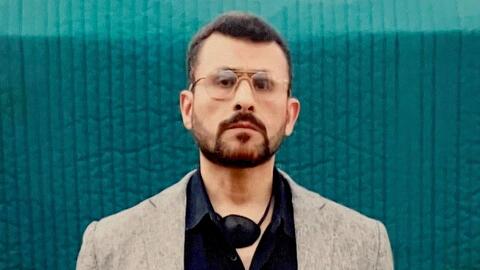
A recent photo of Abu Zubaydah, taken at Guantánamo by representatives of the International Committee of the Red Cross.
If you can, please make a donation to support our work throughout 2026. If you can become a monthly sustainer, that will be particularly appreciated. Tick the box marked, "Make this a monthly donation," and insert the amount you wish to donate.
By Andy Worthington, March 28, 2026
Today, March 28, marks the 24th anniversary of one of the bleakest episodes in the whole of the "war on terror" — the storming, by U.S. and Pakistani forces, of a guest house in Faisalabad, Pakistan, and the abduction and disappearance of its residents; most prominently, Abu Zubaydah, a Saudi-born Palestinian and the gatekeeper of an independent training camp in Afghanistan, who had been incorrectly assessed as a prominent figure in Al-Qaeda, even though some FBI analysts, at least, were aware that this was a spurious claim.
Severely wounded in the firefight that took place when the house was stormed, Abu Zubaydah, whose real name is Zayn al-Abidin Muhammad Husayn, was, nevertheless, soon sent to be tortured in Thailand, the first location of a global network of CIA "black site" torture prisons in which he was the first victim, and spent the next four and a half years in various "black sites" around the world — in Poland, Morocco, Lithuania and Afghanistan — before being sent to Guantánamo with 13 other "high-value detainees" in September 2006, where he has been held ever since without charge or trial.
In the CIA "black sites," he was subjected to waterboarding — a form of barely controlled drowning, which the U.S. authorities called "enhanced interrogation," but which the Spanish Inquisition at least had the decency to call "tortura del agua" — on 83 separate occasions. He was also held in a small coffin-sized box, stripped and hung while painfully shackled, and subjected to loud music and white noise designed to make sleeping impossible.
The CIA operatives who engaged in his torture were so alarmed that he would die, and that they would be held accountable, that they sent a request to CIA headquarters in Langley, seeking reassurances that, if he survived, he "should remain incommunicado for the remainder of his life," a request that was granted.
Abu Zubaydah has not quite been held incommunicado for the rest of his life, because he has attorneys who represent him at Guantánamo, but the censorship regime at the prison is so sweeping — and especially for the "high-value detainees" — that little has been heard from him directly.
In addition, although he has never been charged, and the U.S. authorities have walked back from all of their initial claims that he was the number 3 in Al-Qaeda, with knowledge of the 9/11 attacks, they have also demonstrated that they have no intention of letting him go.
As one of three men at Guantánamo, out of the 15 still held, who have never been charged, but have never been approved for release either, he has, for over a decade, been subjected to an administrative review process, the Periodic Review Boards, in which, every few years, officials from the government and the intelligence agencies gather to look at his case and to recommend his ongoing imprisonment on no discernible basis, except, we can infer, to fulfil that initial request, from 24 years ago, that he must never be freed.
His most recent PRB hearing was on June 27, 2024, but although one of his attorneys, Solomon Shinerock, presented a compelling rationale for his release, almost 18 months later, on December 12, 2025, when the board finally issued its latest determination in his case, they stated that his continuing imprisonment "remains necessary to protect against a continuing significant threat to the security of the United States" without even providing a single reason.
In September 2023, two of his attorneys, Helen Duffy of Human Rights in Practice and Hannah Garry of the UCLA Law Promise Institute for Human Rights, submitted a report to the U.N. Human Rights Committee in which they described the effects of torture on Abu Zubaydah.
As they stated, "As a result of Mr. Abu Zubaydah’s subjection to the U.S. enhanced interrogation program, he and other detainees similarly tortured have suffered lasting physical and psychological injuries, which persist to this day, exacerbated by lack of adequate medical and psychological care at Guantánamo. Following his interrogation, Mr. Abu Zubaydah permanently lost use of his left eye and damage to internal organs due to lack of adequate medical attention. He has blinding headaches, suffers seizures, [and] has permanent brain damage and memory loss as a result of trauma during interrogation. He has frequently lost consciousness at Guantánamo, [and has] experienced unbearable sensitivity to the slightest noise. His amnesia is compounded by being held nearly incommunicado for over 20 years."
Repeated and compelling domestic and international condemnation of Abu Zubaydah’s treatment, and demands for his release
Everything that can be done to secure Abu Zubaydah’s release has been attempted.
In the Senate Intelligence Committee’s report into the CIA torture program, a six-year project that involved a review of six million CIA documents, and whose 600-page executive summary was released in December 2014(released in December 2014), he was mentioned over a thousand times, more than any of the other 118 prisoners formally recognized as having been held in the CIA’s "black sites." However, although the release of the executive summary shocked the world, and briefly sent ripples of disgust through the U.S., no one has been held accountable, and it hasn’t led to any of the grotesque abuses it revealed being addressed.
Twice, in 2014 and 2018, the European Court of Human Rights has ordered European governments — in Poland and Lithuania — to pay him significant damages for his torture in the CIA "black sites" hosted on their territories, and in January this year the British government made a "substantial" payment to him to prevent the U.K.’s Supreme Court from proceeding to a damning judgement about the U.K.’s involvement in his torture, after the court found in his favor in December 2023.
He has also been the subject of an extraordinarily harrowing but essential book, "The Forever Prisoner: The Full and Searing Account of the CIA’s Most Controversial Covert Program," by Cathy Scott-Clark and Adrian Levy, which was published in April 2022, and a documentary film. "The Forever Prisoner," by Alex Gibney, which was released in December 2021.
In April 2023, the U.N. Working Group on Arbitrary Detention issued an opinion about Abu Zubaydah’s case, which I described at the time as "the single most devastating condemnation by an international body that has ever been issued with regard to the U.S.’s detention policies in the 'war on terror.'"
The Working Group found that his continuing imprisonment without charge or trial constitutes arbitrary detention, via the flagrant abuse of the relevant articles of the Universal Declaration of Human Rights, and the International Covenant on Civil and Political Rights, and expressed "grave concern" that the very basis of the detention system at Guantánamo — involving "widespread or systematic imprisonment or other severe deprivation of liberty in violation of fundamental rules of international law" — "may constitute crimes against humanity."
The Working Group also called for his release, and for reparations to be made, but the U.S. government took no interest, prompting a number of U.N. Special Rapporteurs and Working Groups to issue an urgent demand, on January 8, 2025, for his release, in which they highlighted how he had been "arbitrarily detained for over two decades."
The experts called for Abu Zubaydah to be given a Presidential pardon, stated that his "immediate release and relocation to a third safe country are long overdue," and reiterated the Working Group on Arbitrary Detention’s call for him to be "accorded an enforceable right to compensation and other measures of reparation, in accordance with international law."
As they also explained, "We recall the principle of joint responsibility that applies to States when more than one of them was involved in the perpetration of a human rights violation. Accordingly, we call on States to proactively offer their territory for the prompt relocation of Mr. Abu Zubaydah."
The U.S. still won’t release Abu Zubaydah, and no one, sadly, can compel them to do so
Nothing, and no one, however, can force the U.S. to do what it doesn’t want to do regarding the enduring abomination of its treatment of the men still held at Guantánamo, and under Donald Trump, who doesn’t even know his own mind, let alone having any interest in the men still held, it would be foolish to think that any steps will be taken to secure Abu Zubaydah’s release to a country that will offer him the lifelong care he needs.
That country needs to be a supportive third country, because, although he was born and grew up in Saudi Arabia, he was never a citizen, because the Saudi government doesn’t extend citizenship to those born of foreign nationals, like his Palestinian parents. He also can’t be returned to occupied Palestine, because Israel, as the gatekeeper, wouldn’t allow it.
That, however, doesn’t mean that efforts shouldn’t be made to try to find a country that would be prepared to offer him a new home. Trump, hopefully, will not be with us forever, and it must be hoped that the next U.S. government will recognize that, if nothing else, they need to free the six men still held who have never been charged — three already approved for release, and three others, including Abu Zubaydah, who are held as "forever prisoners."
The notion of holding anyone indefinitely without charge or trial ought to be inconceivable in any country that claims to respect the rule of law. Various U.S. administrations have responded over the years to this unassailable truth, slowly — far too slowly — whittling down the numbers of men held without charge or trial at Guantánamo until just this handful remain.
Any future administration that recognizes the need to reclaim some of the U.S.’s fundamentally endangered rights should act decisively to free these men, and to find new homes for them if, like Abu Zubaydah, they cannot be safely repatriated.
It’s time for us to start thinking seriously about which countries might want to help the U.S. to finally bring a just resolution to the appalling and otherwise unending injustice suffered by Abu Zubaydah.
Note: A Spanish version of this article, "Se cumplen 24 años desde que se puso en marcha el programa de tortura de EE.UU. con la captura de Abu Zubaydah," is available on the World Can't Wait's Spanish website.