
Public Health Workers Condemn Immigration Detention Conditions at Guantánamo and at ICE Facilities on the U.S. Mainland
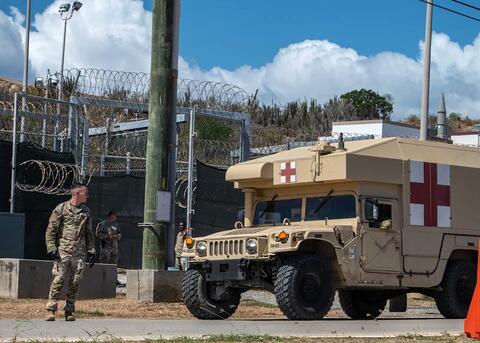
U.S. service members stand by to transport a patient during a simulated medical evacuation at Guantánamo. (Photo: Staff Sgt. Aubree Owens, USAF).
If you can, please make a donation to support our work throughout 2026. If you can become a monthly sustainer, that will be particularly appreciated. Tick the box marked, "Make this a monthly donation," and insert the amount you wish to donate.
By Andy Worthington, February 25, 2026
Since Donald Trump took office for the second time last January, and immediately launched what he described as "the largest domestic deportation operation in American history," we’ve all seen, with horror, how his malignant and invented "war" on immigrants has played out.
Nowhere on the U.S. mainland is safe from armed, masked, marauding and unaccountable thugs working for ICE (Immigration and Customs Enforcement) and the Border Patrol. Nominally, their target is undocumented migrants, primarily from south of the border — central and south America, and the Caribbean, from which, in Trump’s hysterical imagining, the U.S. is facing an "invasion" of dangerous criminals and terrorists.
However, no one of color is safe, whether they are citizens or immigrants, and nor is the U.S.’s white population safe either, as was made horrendously clear just last month, when two white U.S. citizens, Renee Nicole Good and Alex Pretti, were executed by ICE and Border Patrol agents in Minneapolis, one of numerous cities — all under Democratic control — that have been invaded by armies of immigration enforcement officials over the last year, on the basis of false and deeply racist claims that they are overrun by migrant criminals.
Horrifically, ICE has been further empowered through a seven-fold increase in its budget, which was passed by the Republican-controlled Congress last summer, and which has led to a continuing increase in recruitment, accompanied by a steep decline in training standards, and a truly alarming spending spree on vast empty warehouses across the country, intended to more than double the existing number of migrants held — currently over 70,000, the majority with no criminal records — to more than 160,000.
There is, moreover, no guarantee that these "detainees" will be deported, because deporting anyone requires the cooperation of their home governments, and there is, therefore, the very real possibility that what is actually envisioned is an open-ended program of indefinite imprisonment without charge or trial on an industrial scale.
An additional fear is that the remit for detention may expand to include other people regarded as "unwanted" by a government that is obsessed with turning the U.S. into a far-right white supremacist autocracy, with nothing but contempt for both Congress and the courts, even though the power of both is enshrined in the Constitution to provide checks on unfettered executive power.
We know all about the horrors of the mass detention and deportation program because of the bravery of those who have stood up to resist it and to record it on the streets, and because of the lawyers and judges who are doing their best to challenge it, as well as the elected representatives who are also trying to highlight its horrors through visits to ICE’s filthy, violent and overcrowded detention facilities, and the many journalists and media outlets who are also working hard to expose it.
WIRED reports Public Health Service officials’ alarm about immigration detention facilities, including Guantánamo
What we have heard very little from, however, are those enforcing the administration’s vile policies, although recently WIRED published a detailed article, "Public Health Workers Are Quitting Over Assignments to Guantánamo," exposing horrendous conditions at the detention center established on the naval base at Guantánamo Bay, as well at other ICE detention facilities on the mainland.
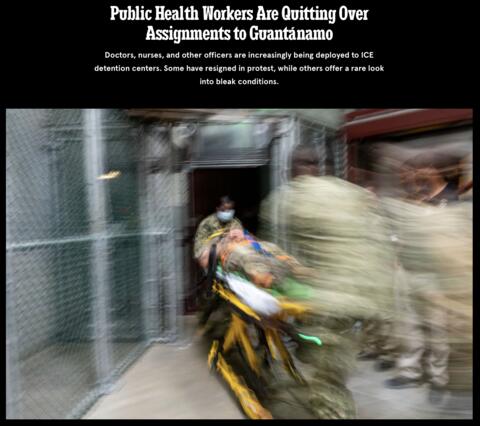
WIRED's article about public health workers and Guantánamo.
The immigration detention center was established at Guantánamo last February, incorporating an existing Migrant Operations Center, used since the 1980s to intercept migrants at sea, and — illegally — part of the "war on terror" prison established in January 2002, and we have reported on it frequently ever since.
The WIRED article drew on the testimony of doctors, nurses, and other officers with the U.S. Public Health Service, which is part of the federal government, but not a branch of the U.S. military, although, as the article explains, "its uniformed officers — roughly 5,000 doctors, nurses, and other health workers — act like stethoscope-wearing soldiers in emergencies. The government deploys them during hurricanes, wildfires, mass shootings, and measles outbreaks. In the interim, they fill gaps at an alphabet soup of government agencies."
The article was written by Amy Maxmen, who works for KFF Health News, a national newsroom producing in-depth journalism about health issues, which is one of the core operating programs at KFF, which describes itself as "the independent source for health policy research, polling, and journalism."
As she explained in her article, "The Trump administration’s mass arrests to curb immigration have created a new type of health emergency as the number of people detained reaches record highs." Regarding the use of Guantánamo, she cited Homeland Security director Kristi Noem’s claim that it would hold "the worst of the worst," but pointed out numerous news reports revealing that "many of the men shipped to the base had no criminal convictions," and also noting that "as many as 90 percent of them were described as 'low-risk' in a May progress report from a chaplain observing the detainees."
As she also explained, "While some Public Health Service officers have provided medical care to detained immigrants in the past, this is the first time in American history that Guantánamo has been used to house immigrants who had been living in the U.S."
One of Maxmen’s main sources was PHS nurse Rebekah Stewart, who resigned rather than accepting a deployment to Guantánamo.
Unwilling to be deployed there, she requested another assignment, and "was instructed to report to an ICE detention center in Texas," but, having had earlier experience of ICE’s detention policies, and "seeing no option but to refuse deployments that she found objectionable," she "resigned after a decade of service," even though, as she said, "It was one of the hardest decisions I ever had to make. It was my dream job."
As she explained to Maxmen, however, "Public health officers are being asked to facilitate a man-made humanitarian crisis."
Stewart had reached her conclusions after "previous deployments, during Trump’s first term, to immigration processing centers run by Customs and Border Protection," where, she recalled, "Fifty women were held in a single concrete cell in Texas." She added, "The most impactful thing I could do was to convince the guards to allow the women, who had been in there for a week, to shower," but conceded that, overall, "I witnessed suffering without having much ability to address it."
As she grappled with whether or not to resign, she spoke with one of her PHS colleagues, another nurse, Dena Bushman, and with other PHS officers who had all been embedded at the Centers for Disease Control and Prevention (CDC) last year. As Maxmen explained, "They assisted with the agency’s response to ongoing measles outbreaks, with sexually transmitted infection research, and more." She added that their roles "became crucial last year as the Trump administration laid off droves of CDC staffers."
Stewart, Bushman, and some other PHS officers at the CDC, "met with middle managers to ask for details about the deployments: If they went to Guantánamo and ICE facilities, how much power would they have to provide what they considered medically necessary care? If they saw anything unethical, how could they report it? Would it be investigated? Would they be protected from reprisal?"
Stewart and Bushman said that "they were given a PHS office phone number they could call if they had a complaint while on assignment. Otherwise, they said, their questions went unanswered."
Like Stewart, Bushman also received a notice to report to Guantánamo, but she too resigned. She told Maxmen, "This may sound extreme, but when I was making this decision, I couldn’t help but think about how the people who fed those imprisoned in concentration camps were still part of the Nazi regime."
Although neither Stewart nor Bushman went to Guantánamo, Maxmen explained how "other public health officers, who worked at Guantánamo in the past year, described conditions there for the detainees, some of whom first learned they were in Cuba from the nurses and doctors sent to care for them."
As she described it, the officers, who were "granted anonymity because they fear[ed] retaliation for speaking publicly," said that "they treated immigrants detained in a dark prison called Camp 6, where no sunlight filters in." The officers also said that they "were not briefed ahead of time on the details of their potential duties at the base."
While Stewart, Bushman and others have resigned from PHS, "many officers remain." Although they are "alarmed by Trump’s tactics," they recognize that "detained people need care."
"We do the best we can to provide care to people in this shit show," one PHS nurse who worked in detention facilities last year said, adding, "I respect people and treat them like humans. I try to be a light in the darkness, the one person that makes someone smile in this horrible mess."
The officers conceded, however, that "their power to protect people was limited in a detention system fraught with overcrowding, disorganization, and the psychological trauma of uncertainty, family separations, and sleep deprivation."
Lessons from Guantánamo’s past
In addition, although both Stewart and Bushman resigned before reporting to Guantánamo, PHS officers who were deployed there "said that they weren’t given details about their potential duties — or the standard operating procedure for medical care — before they arrived."
For Stephen Xenakis, a retired Army general and psychiatrist who has advised on medical care at Guantánamo for two decades, that was "troubling." As he explained, "Before health workers deploy, they should understand what they’ll be expected to do."
As Maxmen noted, "The consequences of going in blind can be severe. In 2014, the Navy threatened court martial against one of its nurses at Guantánamo who refused to force-feed prisoners on hunger strike, who were protesting inhumane treatment and indefinite detention. The protocol was brutal: A person was shackled to a five-point restraint chair as nurses shoved a tube for liquid food into their stomach through their nostrils."
As Xenakis said of the nurse, "He wasn’t given clear guidance in advance on how these procedures would be conducted at Guantánamo. Until he saw it, he didn’t understand how painful it was for detainees."
As Maxmen also explained, "The American Nurses Association and Physicians for Human Rights sided with the nurse, calling the procedure a violation of the ethical standards of medical professionals. After a year, the military dropped the charges."
As Xenakis also explained, "A uniformed doctor’s or nurse’s power tends to depend on their rank, their supervisor, and chains of command." As Maxmen noted, Xenakis "helped put an end to some inhumane practices at Guantánamo more than a decade ago, when he and other retired generals and admirals publicly objected to a technique called 'walling,' in which interrogators slammed the heads of detainees suspected of terrorism against a wall." Xenakis "argued that science didn’t support walling as an effective means of interrogation and that it was unethical, amounting to torture."
Maxmen added, "Torture hasn’t been reported from Guantánamo’s immigration operation, but ICE shift reports obtained through a Freedom of Information Act request by the government watchdog group American Oversight note concerns about detainees resorting to hunger strikes and self-harm." One entry from last July noted, "De-escalation of potential pod wide hunger strike/potential riot. Speak with alien on suicide watch regarding well being."
PHS officials pointed out that, although there is a Navy hospital on the base, it "mainly serves the military and other residents who aren’t locked up — and in any case, its capabilities are limited," as has long been evident from the lack of availability of necessary care for the men held in the "war on terror" prison, who, in addition, are prevented under U.S. law from being sent for treatment on the U.S. mainland.
As Maxmen proceeded to explain, "To reduce the chance of expensive medical evacuations back to the U.S. to see specialists quickly, they said the immigrants were screened before being shipped to Guantánamo. People over age 60 or who needed daily drugs to manage diabetes and high blood pressure, for example, had generally been excluded," although some detainees still "had to be evacuated back to Florida."
On their return, they were screened again, and the doctors and nurses "provided ongoing care, fielding complaints about gastrointestinal distress and depression." In an effort to improve conditions, one psychologist "started an exercise group" for detainees.
However, "Doctors’ requests for lab work were often turned down because of logistical hurdles, partly due to the number of agencies working together on the base. Even a routine test, a complete blood cell count, took weeks to process versus hours in the U.S."
Delayed medical care has been reported by detainees and through investigations at immigration detention facilities throughout the U.S., as well as "dangerous conditions, including overcrowding and a lack of sanitation." As Maxmen pointed out, "Thirty-two people died in ICE custody in 2025, making it the deadliest year in two decades."
As one PHS officer described it, "They are arresting and detaining more people than their facilities can support." The officer also said that the "most prevalent problem" was "psychological" — worries about "never seeing their families again or being sent back to a country where they feared they’d be killed."
"People are scared out of their minds," the officer added.
At Guantánamo, one PHS officer, who helped medically screen new arrivals, said that the detainees were "often surprised to learn" where they were. "I’d tell them, I’m sorry you are here," the officer said, but added, "No one freaked out. It was like the 10-millionth time they had been transferred." Some of the men, as the officer also explained, "had been detained in various facilities for five or six months and said they wanted to return to their home countries," although the health workers "had neither an answer nor a fix."
Unlike ICE detention facilities in the U.S., however, "Guantánamo hasn’t been overcrowded," as Maxmen described it. One officer said, "I have never been so not busy at work," although, despite the activities on offer for U.S. personnel — snorkeling, paddleboard yoga, and kickboxing — they said they would "rather be home than on this assignment on the taxpayer’s dime."
Costs, bloated budgets and unforeseen consequences
Maxmen also discussed the cost of holding migrants at Guantánamo, because "transporting staff and supplies to the island and maintaining them on base is enormously expensive." She noted that the government "paid an estimated $16,540 per day per detainee at Guantánamo to hold those accused of terrorism, according to a 2025 Washington Post analysis of DOD data," whereas "the average cost to detain immigrants in ICE facilities in the U.S. is $157 per day."

The cover of the Congressional Democrats' report about Guantánamo.
Maxmen also noted how ICE’s funding has "skyrocketed," with Congress granting it "a record $78 billion for fiscal year 2026, a staggering increase from $9.9 billion in 2024 and $6.5 billion nearly a decade ago." As she also noted, "Last year, the Trump administration also diverted more than $2 billion from the national defense budget to immigration detention, according to a report from congressional Democrats," and "about $60 million of it went to Guantánamo."
Nevertheless, in a declaration submitted as part of a lawsuit brought by the ACLU last year, Deborah Fleischaker, a former assistant director at ICE, made a point of stating, "Detaining noncitizens at Guantánamo is far more costly and logistically burdensome than holding them in ICE detention facilities within the United States."
And Anne Schuchat, who served with the PHS for 30 years, noted that "PHS deployments to detention centers may cost the nation in terms of security, too." As she said, "A key concern has always been to have enough of these officers available for public health emergencies." In the past, PHS officers "have stood up medical shelters during hurricanes in Louisiana and Texas, rolled out Covid testing in the earliest months of the pandemic, and provided crisis support after the deadly shooting at Sandy Hook Elementary School and the Boston Marathon bombing."
For her part, Rebekah Stewart concluded, "It’s important for the public to be aware of how many government resources are being used so that the current administration can carry out this one agenda." She added, "This one thing is probably turning us into the types of countries we have fought wars against."