Guantánamo at 24: 19 Global Vigils, 135 Photos and Three Videos
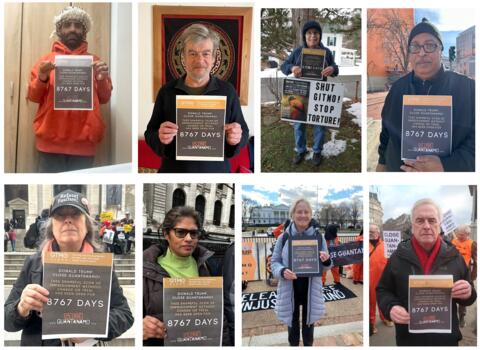
Eight of the 79 photos we received of campaigners with our Gitmo Clock poster marking 8,767 days of Guantánamo's existence on January 11.
If you can, please make a donation to support our work in 2026. If you can become a monthly sustainer, that will be particularly appreciated. Tick the box marked, "Make this a monthly donation," and insert the amount you wish to donate.
By Andy Worthington, January 19, 2026
January 11 marked the 24th anniversary of the opening of the "war on terror" prison at Guantánamo Bay, and 14 years since the U.S. attorney Tom Wilner and I established the Close Guantánamo campaign to call for the prison’s closure, and to tell the stories of the men held there.
At the time, Guantánamo was languishing in one of its periodic troughs of amnesia. Although Barack Obama had been elected as the president in November 2008 on a promise to close the prison, he had failed to do so.
Beset by cynical Republican opposition, he had instead, by January 2012, largely given up on releasing anyone at all from Guantánamo, a situation that was only reversed when, in February 2013, the prisoners themselves forcefully brought Guantánamo back to the attention of the world’s media (and of President Obama) by embarking on a prison-wide hunger strike.
On the 24th anniversary of the opening of Guantánamo, the prison is, arguably, more forgotten than ever before, even though its many, monstrous and ongoing injustices are not just historic, but continue to affect the 15 men still held there.
Those injustices involve, fundamentally, the assertion, made by the Bush administration when it opened the prison, that it had the right to seize anyone anywhere around the world and, without any meaningful screening mechanism, or any kind of due process, hold them indefinitely without charge or trial, possibly for the rest of their lives. To achieve this monstrously lawless sleight of hand, the administration defined them as "enemy combatants," human beings with no fundamental rights whatsoever.
A second assertion was that, if any of these prisoners were to be charged, it would be via military commissions, a trial system unwisely dredged up from the history books, and fundamentally incapable of delivering anything resembling the kind of justice available in the U.S. court system.
The injustices of Guantánamo also continue to exert a baleful influence on current U.S. policy. It is no accident that, when Donald Trump took office for the second time a year ago, and almost immediately announced plans to hold migrants at Guantánamo, as part of the fulfilment of his horribly racist promise to undertake the largest deportation program in U.S. history, he chose Guantánamo in an effort to conflate the "war on terror" with his own "war on migrants."
Moving migrants to Guantánamo was meant to suggest that the U.S. faced an existential threat from immigration, comparable to the terrorist attacks of September 11, 2001, and that those responsible for what he described as an "invasion," seeking to infer that the U.S. was facing an unprecedented "national emergency" and was at war with anyone on its soil who was not born there, should have no rights.
At Guantánamo, Trump’s efforts have been rebuked by the District Court in Washington, D.C. (although he has, as is typical, failed to observe the court’s order), but elsewhere his massive expansion of the Department of the Homeland Security and its ICE program for migrants’ detention and removal — both, noticeably, created during the U.S.’s post-9/11 hysteria, reinforcing the false analogies with the "war on terror" — has already involved creating new prison facilities across the country that are based on the false premise that there should be facilities on the U.S. mainland that are outside the law.
The most notorious examples are Alligator Alcatraz and Krome, in Florida, which, in December, were condemned by Amnesty International as systematically involving "torture and enforced disappearances." One Cuban man held at Alligator Alcatraz called it a "copy of Guantánamo."
And right now, in Minnesota, where ICE (Immigration and Customs Enforcement) are waging war on the people of Minneapolis, with thousands of people detained over the last two weeks, "Multiple attorneys allege that for some of those detained, including at least one U.S. citizen, the Department of Homeland Security is denying their constitutional right to see an attorney," as ABC News reported today.
One attorney told ABC News that an ICE agent had told them, "If we let you see your clients, we would have to let all the attorneys see their clients, and imagine the chaos," to which they replied, "Yeah, you do have to let all the attorneys see their clients. You do have to accommodate that. That’s the Constitution. You chose to put them here. I didn't bring this guy here, you did."
As I noted on X, making a comparison with Guantánamo, "In the 'war on terror,' the Bush administration stripped those captured and sent to Guantánamo of ALL their rights as human beings. It took two and a half years for them to secure access to attorneys. The government argued that everyone it seized was an 'enemy combatant' and no proof was required."
The 19 global vigils and the Gitmo Clock photos
In the deeply troubling atmosphere in the U.S. right now, characterized in an article for Byline Times, "A Year of Living Dangerously in Trump’s America," by former British diplomat Alexandra Hall Hall, as a place where "it is no longer entirely safe to speak freely," where "extra-judicial executions, such as happened with Renee Good, killed by an ICE officer, can take place," and where "forced disappearances have become routine," I’m hugely grateful to the numerous individuals who took a stand last weekend to take part in vigils marking the 24th anniversary of Guantánamo, and to continue calling for the prison’s closure and for freedom or justice for the 15 men still held.
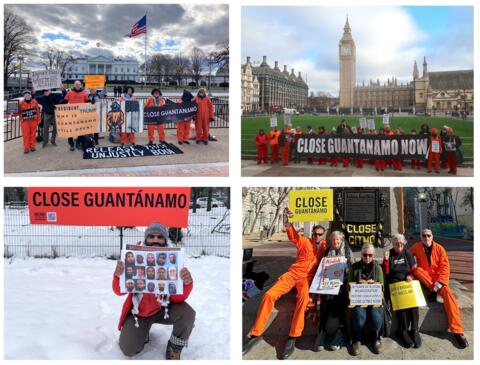
Photos from four of the 19 global vigils for the closure of Guantánamo marking the 24th anniversary of the prison's opening on January 11, 2026.
The vigils, part of the monthly vigils for Guantánamo’s closure, which I initiated, and which have been taking place across the U.S. and around the world for the last three years, took place at 12 locations in the U.S. — outside the White House in Washington, D.C., in New York, San Francisco, Los Angeles, Portland, Detroit, Cobleskill, NY, Augusta, ME, Cleveland, Greenfield, MA, Raleigh, NC and Hawaii. Six other vigils took place in Europe — in London, Brussels, Rome, Warsaw, Shannon in Ireland and Belgrade — while another took place in Mexico City.
Please see my article on my website, Photos and Report: 19 Global Vigils for the Closure of Guantánamo on the 24th Anniversary of the Prison’s Opening, for my report, which features 57 photos from these vigils.
Next month, the regular "First Wednesday" vigils resume, on Wednesday February 4, with eleven groups of participants, and I hope you can join us. As I noted in my article, "We may be small in number, but every effort we make reflects the concerns of many, and also helps to keep alight a beacon of outrage, however small. Without it, there would be only darkness."
As well as holding vigils, many of those involved also took part in our latest photo campaign, which involves campaigners taking photos with posters we make available every 100 days, and on the anniversaries of the prison’s opening, via our Gitmo Clock website, which counts in real time how long Guantánamo has been open.
January 11 marked 8,767 days, and 79 campaigners across the U.S. and around the world sent in photos, which can all be seen on our new dedicated page on our website here. More posters for 2026 will be made available soon.
Three videos
And finally, for now, please see below for three videos marking the anniversary.
The first is the speech I gave at the London vigil in Trafalgar Square on January 10, in which I discussed Donald Trump’s depraved use of Guantánamo as a venue of performative cruelty in his "war on migrants," and also spoke about the chronic injustices faced by the 15 men still held, focusing on the case of Muieen Abd Al-Sattar.
Approved for release by a high-level U.S. government review process 16 years ago, he is still held because, for whatever reason, he refuses to engage with the authorities and has never sought representation by an attorney, and even his nationality appears to be unknown. As a result, he has disappeared through cracks in the detention system that no one envisaged when the prison was set up, and no one has sought to address, disappearing as a ghost in Guantánamo, with no sign of how, if ever, he might be freed.
The second is a 20-minute interview I undertook with the South African broadcaster Salaamedia, whose focus on human rights and justice is a world away from the indifference or even hostility of most western media.
The third is an hour-long interview with Scott Horton, a tireless author and broadcaster, with whom I’ve been discussing Guantánamo and the crimes of successive U.S. governments for nearly 20 years, and watching as his anti-war libertarianism has become ever more popular.
Note: For a Spanish translation, on the World Can't Wait's Spanish website, see "Guantánamo a los 24 años: 19 vigilias globales, 135 fotos y tres vídeos" here.